Quick answer: Our overall recommendation is Ueno, Okachimachi, or Asakusa
If this is your first Tokyo trip and you plan to cover the classic sights, our overall recommendation is Ueno, Okachimachi, or Asakusa—unless your main priority is Haneda Airport access, the Tokaido Shinkansen, western Tokyo sightseeing, or nightlife.
Start with Ueno or Okachimachi if you want a good balance of transport and sightseeing. Start with Asakusa if early-morning walks around Senso-ji and the atmosphere of old Tokyo matter more. Ueno and Okachimachi give you the JR Yamanote and Keihin-Tohoku lines plus several subway lines. They are convenient for Asakusa, Akihabara, Tokyo Station, and Ginza, while Shinjuku and Shibuya are still reachable without a transfer. Keisei Ueno also provides access to Narita Airport. Museums, temples, shopping, and a wide range of restaurants are close at hand.
That does not make this group the best choice for everyone. If most of your plans are around Ginza, Tsukiji, and Tokyo Station, compare Ginza and Shimbashi with the Tokyo Station area. Choose Shinjuku for western Tokyo, late-night dining, Hakone, or the Fuji Five Lakes. Choose Shibuya if you will repeatedly visit Shibuya, Harajuku, and Omotesando. Akasaka or Roppongi suits museum visits, international dining, and bars, while Hamamatsucho or Shinagawa is stronger when Haneda Airport or the Tokaido Shinkansen is the priority.
Tokyo hotel areas at a glance
Use this table to reduce the list to one or two candidates. The station differences, benefits, drawbacks, and hotel examples are explained in the detailed sections below.
| Area | Why it stands out | Nearby sights |
|---|---|---|
| Ueno, Okachimachi, and Asakusa — overall recommendation | Ueno and Okachimachi combine JR and subway access, making it easier to cover classic sights across Tokyo. The area also works well for Narita, while Asakusa gives you temples and old-Tokyo streets in the quieter morning and evening hours. | Ueno Park, Tokyo National Museum, Ameyoko, Senso-ji, Kappabashi, Tokyo Skytree |
| Ginza and Shimbashi | Ginza, Tsukiji, Tokyo Station, and Nihombashi are nearby. Shimbashi adds JR, subway, and Yurikamome access, while dining ranges from high-end restaurants to casual izakaya. | Ginza Chuo-dori, Kabukiza Theatre, Tsukiji Outer Market, Hamarikyu Gardens, Hibiya Park |
| Shinjuku | JR, subway, private railways, and highway buses meet here. It is useful for western Tokyo, Hakone, and the Fuji Five Lakes, with shopping and late-night dining in the same area. | Shinjuku Gyoen, Tokyo Metropolitan Government Building, Kabukicho, Golden Gai, Omoide Yokocho |
| Shibuya | Harajuku, Omotesando, and Daikanyama are easy to combine, with useful connections toward Yokohama and Shimokitazawa. Fashion, music, shopping, and nightlife are major draws. | Shibuya Scramble Crossing, SHIBUYA SKY, Meiji Jingu, Harajuku, Omotesando |
| Tokyo Station | Shinkansen services, the Narita Express, and highway buses make onward travel easier. Marunouchi, the Imperial Palace, Nihombashi, and Ginza are also close. | Tokyo Station Marunouchi Building, Kokyo Gaien National Garden, Marunouchi, Nihombashi, KITTE |
| Akasaka and Roppongi | Several subway lines serve the area, and museums, international restaurants, and bars can be combined on foot. Ginza, Shibuya, and other central districts are within reach. | Hie Shrine, Roppongi Hills, Tokyo Midtown, The National Art Center Tokyo, Azabudai Hills |
| Hamamatsucho and Shinagawa | Both work well for Haneda. Hamamatsucho has the Tokyo Monorail, while Shinagawa has the Tokaido Shinkansen. They also suit trips continuing to Yokohama, Nagoya, Kyoto, or Osaka. | Tokyo Tower, Zojoji Temple, Kyu-Shiba-rikyu Gardens, Sengakuji Temple, Tennozu Isle |
Map: where the areas are and how to choose between them
The illustration places the seven hotel-area groups around representative JR Yamanote Line stations and a small set of landmarks.
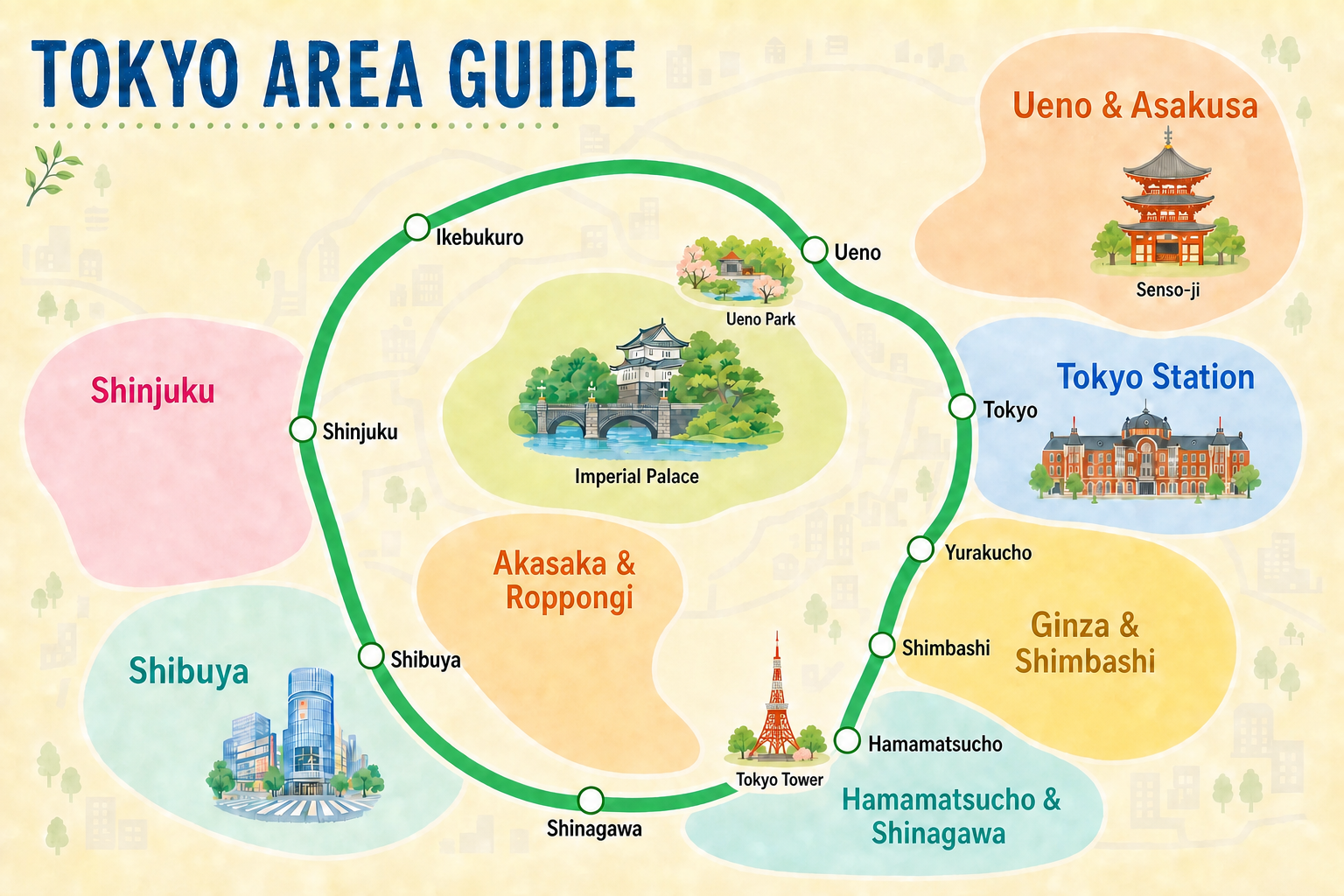
Asakusa, Akasaka, and Roppongi are not directly on the Yamanote Line. Check the station details in each area section before choosing a hotel.
Recommended areas to stay in Tokyo
Ueno, Okachimachi, and Asakusa: our top recommendation for a first Tokyo trip
Representative stations:
- Ueno: Ueno for JR and Tokyo Metro; Keisei Ueno
- Okachimachi: Okachimachi, Ueno-hirokoji, Naka-okachimachi, and Ueno-okachimachi
- Asakusa: Asakusa for Tokyo Metro, Toei Subway, and Tobu; a separate Asakusa station for the Tsukuba Express
For a first Tokyo trip covering the classic sights, this is our overall recommendation unless your main priority is Haneda Airport access, the Tokaido Shinkansen, western Tokyo sightseeing, or nightlife. These are three separate station areas with different roles: choose Ueno or Okachimachi for transport and broad sightseeing, and Asakusa for early and late walks around Senso-ji and a more distinctive old-Tokyo stay.
Ueno has the JR Yamanote and Keihin-Tohoku lines, the Ginza and Hibiya subway lines, and Shinkansen services toward Tohoku, Joetsu, and Hokuriku. Nearby Keisei Ueno has the Skyliner to Narita Airport. Tokyo Station, Akihabara, Ginza, and Asakusa are easy to reach, while JR takes you to Shinjuku and Shibuya without a transfer. Ueno Park’s museums, the zoo, and Ameyoko are within walking distance, so the area also works well on arrival days or slower days.
Okachimachi is more than the station next to Ueno. JR Okachimachi sits close to Ueno-hirokoji, Naka-okachimachi, and Ueno-okachimachi subway stations, giving you the Yamanote, Keihin-Tohoku, Ginza, Hibiya, and Oedo lines. It can be easier than using large Ueno Station every day, especially if you want to walk between Ueno, Ameyoko, and Akihabara. Restaurants and everyday shops are plentiful, so dinner and basic shopping do not require another train journey.
Asakusa is the choice for Senso-ji, Nakamise, Kappabashi, the Sumida River, and Tokyo Skytree. Staying here lets you walk around Senso-ji before daytime crowds arrive or after many visitors have left. The trade-off is that Asakusa has no JR station. The Tokyo Metro, Toei, and Tobu station group is also separate from the Tsukuba Express station. Ueno and Okachimachi are stronger for transport; Asakusa offers the more memorable old-Tokyo stay.
Nearby sights: Ueno Park, Tokyo National Museum, National Museum of Nature and Science, Ueno Zoo, Ameyoko, Senso-ji, Nakamise, Kappabashi, Tokyo Skytree
Benefits
- Keisei Ueno provides a direct Skyliner route to and from Narita Airport
- Ueno and Okachimachi combine JR and subway lines for easier trips to Tokyo Station, Akihabara, Ginza, and Asakusa
- Okachimachi’s nearby subway stations and walkable position make it easy to move between Ueno, Ameyoko, and Akihabara
- Ueno Park’s museums and the Asakusa–Skytree area can be combined in one day
- Food experiences range from Ameyoko snacks to sushi, tempura, and sweets in Asakusa
- An Asakusa stay makes early-morning and evening walks around Senso-ji easier
Drawbacks
- JR Ueno Station has several levels, and reaching the Shinkansen platforms takes time
- JR Ueno and Keisei Ueno are separate stations. Transfers require walking outside the ticket gates, so allow extra time with luggage whether you use the street or underground route
- Streets around Ueno and Okachimachi can be busy and lively at night; travelers seeking quiet should also compare hotels away from the main entertainment streets
- Asakusa stations are split between railway companies rather than combined into one station complex
- The Senso-ji area can be very crowded during the day in busy travel periods
- This group is less suitable if you will visit Shinjuku or Shibuya every day or prioritize late-night bars and clubs
- Ueno’s Shinkansen services run toward Tohoku, Joetsu, and Hokuriku; the Tokaido Shinkansen for Kyoto and Osaka does not stop here
- Other areas are stronger when Haneda, the Tokaido Shinkansen, or western Tokyo is your main priority
How to choose the station area
Choose Ueno for Narita access, JR and Shinkansen journeys, and museums. Choose Okachimachi if you want several rail and subway options with a smaller station and walkable access to Ueno and Akihabara. Choose Asakusa for early or evening walks around Senso-ji and the atmosphere of old Tokyo. Before booking, compare JR Ueno with Keisei Ueno, the four stations around Okachimachi, and the two separate Asakusa station groups.
Three hotel examples in Ueno, Okachimachi, and Asakusa
| Location focus | Hotel | Why consider it |
|---|---|---|
| Ueno and JR access | Hotel New Ueno | Close to JR Ueno Station’s Asakusa Exit for travelers who expect to use JR frequently. |
| Okachimachi and multiple lines | hotel MONday Premium Ueno Okachimachi | Close to Naka-okachimachi and within walking distance of JR Okachimachi, making it useful for combining JR with the Hibiya, Ginza, and Oedo lines. |
| Asakusa and subway access | Hotel Gracery Asakusa | Convenient for the Toei Asakusa and Ginza lines, with easier access to early and evening walks around Senso-ji. |
Ginza and Shimbashi: central-east sightseeing with excellent dining
Representative stations: Ginza, Higashi-ginza, Yurakucho, Shimbashi, Shiodome
Ginza and Shimbashi form a practical base for central and eastern Tokyo, including Ginza, Tsukiji, Tokyo Station, Nihombashi, and Asakusa. Ginza has department stores, Kabukiza Theatre, galleries, long-established restaurants, and high-end dining. Shimbashi has more casual restaurants and izakaya, giving you a broader range of evening options.
The useful lines vary within the area. Ginza Station has the Ginza, Marunouchi, and Hibiya lines; Higashi-ginza has the Hibiya and Toei Asakusa lines; Shimbashi has JR, the Ginza Line, the Toei Asakusa Line, and Yurikamome. The district name alone does not determine convenience. Choose the part of the area closest to the lines you will actually use.
More specifically, Ginza and Higashi-ginza suit days built around Kabukiza, Tsukiji, and department stores. Yurakucho and Shimbashi are better when you will repeatedly use JR, while Shimbashi and Shiodome work well for Hamarikyu and Odaiba. The Karasumori side of Shimbashi is lively and has many affordable places to eat. If you want a calmer night, also compare the Ginza and Shiodome sides. Do not assume one price level or nighttime atmosphere simply because the hotel uses “Ginza” in its name.
Nearby sights: Ginza Chuo-dori, Kabukiza Theatre, Tsukiji Outer Market, Hamarikyu Gardens, Hibiya Park, Shiodome, Yurakucho
Benefits
- Ginza, Tsukiji, Hamarikyu, and Hibiya are easy to combine on foot or with short train rides
- Shimbashi gives you JR, the Ginza Line, the Toei Asakusa Line, and Yurikamome
- Some Toei Asakusa Line trains continue onto the Keikyu Line toward Haneda without a transfer
- Tokyo Station is nearby, which helps when a Shinkansen journey is part of the itinerary
- You can choose between refined dining in Ginza and casual izakaya around Shimbashi
Drawbacks
- The area is broad, and the most useful lines differ between the Ginza and Shimbashi sides
- Ginza Station has no JR service, so JR-focused travelers may walk to Yurakucho or Shimbashi
- Shimbashi is especially busy during commuter hours
- Popular Ginza restaurants may require reservations; if you prefer casual, unplanned meals, the Shimbashi side may suit you better
- The atmosphere will not suit travelers looking for a quiet residential neighborhood or traditional low-rise streets
How to choose the station area
A hotel with “Ginza” in its name may actually be closer to Higashi-ginza, Shimbashi, or Tsukiji. Check the nearest station and exit for the lines you plan to use.
Three hotel examples in Ginza and Shimbashi
| Hotel style | Hotel | Why consider it |
|---|---|---|
| Compact and location-first | Sotetsu Fresa Inn Ginza Sanchome | Useful for combining Ginza, Higashi-ginza, and Yurakucho stations. |
| Balanced location and facilities | THE GATE HOTEL Tokyo by HULIC | On the Hibiya–Yurakucho side, with practical JR and subway access for Ginza and the Imperial Palace area. |
| Rooms and service first | Conrad Tokyo | For travelers prioritizing views, hotel facilities, service, and access toward Ginza and Odaiba. |
Shinjuku: convenient for western Tokyo, Hakone, and the Fuji Five Lakes
Representative stations: JR Shinjuku, Shinjuku-sanchome, Higashi-shinjuku, Seibu-Shinjuku, Tochomae
Shinjuku is a major transport hub for travelers focusing on western Tokyo, late-night dining, or day trips toward Hakone and the Fuji Five Lakes. JR, Tokyo Metro, Toei Subway, Odakyu, and Keio services meet here. Odakyu trains run toward Hakone, while highway buses from Busta Shinjuku serve destinations including the Lake Kawaguchiko area.
Shinjuku is not automatically Tokyo’s most convenient hotel area. If many of your days are in Asakusa, Ueno, or Ginza, you will spend more time crossing Tokyo. Shinjuku, Shinjuku-sanchome, Higashi-shinjuku, and Seibu-Shinjuku are also separate stations. Do not choose a hotel from the word “Shinjuku” alone.
The route from the railway company, ticket gate, and exit you use matters more than the advertised walking time. The south side suits Busta Shinjuku and highway-bus users. The west side and Tochomae work for high-rise hotels and relatively calmer evenings, while the east and Kabukicho sides suit travelers who want late-night dining and entertainment. Construction and passage changes can alter walking routes, so travelers with large luggage should check a current photo route and elevator locations before arrival.
Nearby sights: Shinjuku Gyoen, Tokyo Metropolitan Government Building observatories, Kabukicho, Golden Gai, Hanazono Shrine, Omoide Yokocho, Shin-Okubo
Benefits
- Many JR, subway, and private-railway options for western Tokyo
- Odakyu trains toward Hakone and highway buses toward the Fuji Five Lakes
- Shinjuku Gyoen, the government observatories, electronics shopping, dining, and night views are available within the area
- Evening choices range from ramen and izakaya to bars and high-rise restaurants
- Staying nearby shortens the trip home after a late night in Shinjuku
Drawbacks
- Numerous railway companies, gates, and exits make orientation difficult on a first visit
- Crossing between the east, west, and south sides can be tiring with luggage
- Travel time adds up when Asakusa, Ueno, and Ginza dominate the itinerary
- Direct trains and airport buses exist, but Ueno is generally easier to understand for Narita, while Hamamatsucho or Shinagawa is more straightforward for Haneda
- Hotels near Kabukicho may not suit travelers looking for a quiet night
How to choose the station area
For a first Shinjuku stay, beginning with the south side near JR Shinjuku’s South Exit and Busta Shinjuku can make the search easier. The east side suits Kabukicho and late-night dining; the west side suits the government buildings and large hotels; Shinjuku-sanchome suits Shinjuku Gyoen and subway-based days.
Three hotel examples in Shinjuku
| Hotel style | Hotel | Why consider it |
|---|---|---|
| Compact and location-first | Hotel Sunroute Plaza Shinjuku | Convenient for JR Shinjuku’s South Exit, Toei Subway services, and Busta Shinjuku. |
| Balanced location and facilities | Odakyu Hotel Century Southern Tower | Faces Southern Terrace and works well for south-side rail and highway-bus journeys. |
| Rooms and service first | Keio Plaza Hotel Tokyo | On the west side near Tochomae for travelers who prioritize hotel facilities, service, and time at the hotel. |
Shibuya: fashion, music, shopping, and southwest Tokyo
Representative station: Shibuya
Shibuya suits travelers focusing on the Scramble Crossing, Harajuku, Omotesando, Daikanyama, shopping, music, and evening dining in southwest Tokyo. JR, Tokyu, Keio, and Tokyo Metro services connect the area, with useful routes toward Yokohama and Shimokitazawa.
The Ginza Line reaches Ginza, Ueno, and Asakusa without a transfer, but a direct train does not make those areas close. If Tokyo Station, Ueno, and Asakusa fill several days, staying farther east may reduce repeated cross-city journeys.
Shibuya is difficult to navigate not only because of the station but also because the area sits in a valley. Slopes, underground platforms, elevated walkways, and multi-level passages are common. Dogenzaka and Udagawacho suit nightlife and entertainment; the Miyamasuzaka side works for subway use and Omotesando; Sakuragaoka offers some distance from the busiest station-front streets. A hotel may be only a few minutes away but still involve an uphill walk. Conversely, some rooms near nightlife streets can still be quiet, so do not judge only by map distance.
Nearby sights: Shibuya Scramble Crossing, SHIBUYA SKY, MIYASHITA PARK, Shibuya PARCO, Meiji Jingu, Harajuku, Omotesando, Daikanyama
Benefits
- Harajuku, Omotesando, and Daikanyama combine easily in one day
- The Yamanote Line serves Shinjuku, the Toyoko Line runs toward Yokohama, and the Inokashira Line serves Shimokitazawa
- Fashion, anime, music, and film culture are easy to explore
- Restaurants, bars, live-music venues, and clubs keep the area active late
- Oku-Shibuya and Daikanyama offer different atmospheres from the station-front streets
Drawbacks
- Gates and platforms are separated by railway company, making transfers and exits complicated
- Station-front crowds make suitcase travel tiring
- East-Tokyo sightseeing and an early Shinkansen from Tokyo Station create longer journeys
- Hotels near Udagawacho or Maruyamacho may not suit travelers seeking quiet
- Hills make “close to Shibuya Station” an incomplete measure of luggage difficulty
How to choose the station area
Match the exit to the railway line you expect to use. Stay near the main entertainment streets for nightlife, or compare Oku-Shibuya, Daikanyama, and the Ebisu side for a calmer base.
Three hotel examples in Shibuya
| Hotel style | Hotel | Why consider it |
|---|---|---|
| Compact and location-first | Shibuya Tokyu REI Hotel | Near the Miyamasuzaka and B2 exit side for travelers prioritizing station access. |
| Balanced location and facilities | Shibuya Excel Hotel Tokyu | Inside Shibuya Mark City, with practical access to JR, subway, Tokyu, and Keio services. |
| Rooms and service first | Cerulean Tower Tokyu Hotel | On the west side of Shibuya for travelers prioritizing rooms, facilities, service, and views. |
Tokyo Station: convenient for Shinkansen and onward travel
Representative stations: Tokyo, Otemachi, Nihombashi
The Tokyo Station area works well for a multi-city trip that includes Kyoto, Osaka, Tohoku, or other destinations, and for nights before an early Shinkansen. Marunouchi, Nihombashi, Kokyo Gaien National Garden, and Ginza are nearby. The station itself has restaurants, ekiben shops, and souvenir stores.
Staying near Tokyo Station does not make every journey simple. Conventional trains, subway connections, Shinkansen platforms, and underground shopping streets spread over several levels. The Marunouchi and Yaesu sides also have different atmospheres and transport options. The Keiyo Line and Sobu Line underground platforms are notably far from some other platforms.
Choose not only by distance to “Tokyo Station” but also by the Marunouchi, Yaesu, or Nihombashi side. Marunouchi suits the Imperial Palace, the historic station building, and a polished business district. Yaesu and Kyobashi suit highway buses, restaurants, and Nihombashi. The Keiyo Line for the Tokyo Disney Resort area is still a long walk inside the station, so a Tokyo Station hotel does not mean you will board immediately. If station-front prices are high, compare Kyobashi and Nihombashi under the same booking conditions.
Nearby sights: Tokyo Station Marunouchi Building, Kokyo Gaien National Garden, Imperial Palace East Gardens, Marunouchi Naka-dori, KITTE, Nihombashi, Tokyo International Forum, Ginza
Benefits
- Easy access to Tokaido, Tohoku, Joetsu, Hokuriku, and other Shinkansen services
- The Narita Express serves the station, and airport and intercity buses use the Yaesu side
- The Imperial Palace, Marunouchi, Nihombashi, and Ginza combine well
- Meals, ekiben, and souvenirs are available inside the station
- A useful base for short stays and multi-city trips where reducing missed-train or transfer risk matters
Drawbacks
- The station and underground passages are extensive; the wrong gate or exit can cause a major detour
- Keiyo Line, Sobu Line underground, and Shinkansen platforms can involve long internal walks
- The useful transport and neighborhood atmosphere depend on the Marunouchi or Yaesu side
- Shinjuku- and Shibuya-focused trips require repeated east-west travel
- Narrow-lane izakaya districts and club nightlife are less extensive than in Shinjuku, Shibuya, or Shimbashi
How to choose the station area
Choose Marunouchi for the Imperial Palace and Otemachi. Choose Yaesu for airport or highway buses and access toward Nihombashi. Do not rely only on an advertised walking time: check the gate and the route to the exact conventional-train or Shinkansen platform. For an early train, also check station-entrance and breakfast hours.
Three hotel examples around Tokyo Station
| Hotel style | Hotel | Why consider it |
|---|---|---|
| Compact and location-first | Hotel Monte Hermana Tokyo | Useful for travelers who expect to use the Yaesu underground area frequently. |
| Balanced location and facilities | karaksa hotel TOKYO STATION | On the Yaesu north side, with room options that can work for families and groups. |
| Rooms and service first | Marunouchi Hotel | A full-service Marunouchi-side hotel with underground access toward Tokyo Station and Otemachi. |
Akasaka and Roppongi: museums, dining, and nightlife
Representative stations: Akasaka-mitsuke, Akasaka, Tameike-sanno, Roppongi, Roppongi-itchome
Akasaka and Roppongi suit travelers who want central dining, art, and nightlife, but the stations and neighborhood atmospheres differ. Akasaka has the Chiyoda Line; Akasaka-mitsuke has the Ginza and Marunouchi lines; Roppongi has the Hibiya and Oedo lines; Roppongi-itchome has the Namboku Line.
Akasaka-mitsuke works well for subway journeys toward Ginza, Shibuya, and Tokyo Station. Akasaka has dining ranging from traditional restaurants and wine bars to jazz clubs and ramen. Roppongi has museums, high-end restaurants, international cuisine, and bars and clubs that remain open late.
Do not treat this as one universally convenient Minato City district. Akasaka-mitsuke is useful for Shibuya, Ginza, and Tokyo Station; Akasaka connects toward Omotesando and Hibiya; Roppongi connects toward Ebisu, Ueno, and destinations on the Oedo Line. Roppongi is strong when museums, dining, and evening plans can be kept within walking distance, but JR, airports, and Shinkansen stations usually require more travel. The Oedo Line platforms at Roppongi are deep, and noise near Roppongi-dori or the expressway can vary by hotel and room orientation. Check the return route and immediate surroundings, not only the station distance.
Nearby sights: Hie Shrine, Akasaka Hikawa Shrine, Akasaka Palace, Roppongi Hills, Mori Art Museum, Tokyo Midtown, The National Art Center Tokyo, Azabudai Hills
Benefits
- The right station gives useful subway access toward Ginza, Shibuya, and Shinjuku
- Akasaka has a broad dining range, from business dinners to bars and ramen
- Mori Art Museum, The National Art Center Tokyo, and Suntory Museum of Art can be combined in one day
- Roppongi has international restaurants and late-night dining and bars
- Hie Shrine and Akasaka Hikawa Shrine add quieter cultural stops beyond the entertainment and large mixed-use complexes
Drawbacks
- There is no JR station, and airports and Shinkansen stations often require a transfer
- The useful direction changes depending on whether the hotel is near Akasaka, Akasaka-mitsuke, Roppongi, or Roppongi-itchome
- Roppongi’s Oedo Line platforms are deep, so allow extra time with large luggage or a stroller
- Hotels near Roppongi Crossing and the club streets may not suit travelers sensitive to late-night activity
- High-end hotels and restaurants are common, so budget-focused travelers should compare accommodation and meal costs carefully
- Daily trips to Asakusa and Ueno can take more time
How to choose the station area
Choose the Akasaka-mitsuke side for calmer dining and useful subway journeys across central Tokyo. Choose Roppongi for museums, international restaurants, and evening bars. Do not book only because the address is in Minato City; check the exact station and the streets you will use when returning at night.
Three hotel examples in Akasaka and Roppongi
| Hotel style | Hotel | Why consider it |
|---|---|---|
| Compact and location-first | Via Inn Prime Akasaka Akane-no-Yu | Useful for travelers who want to combine Akasaka, Tameike-sanno, and Akasaka-mitsuke stations. |
| Balanced location and facilities | Mitsui Garden Hotel Roppongi Premier | Convenient for Roppongi and Roppongi-itchome, museums, restaurants, and bars. |
| Rooms and service first | The Ritz-Carlton, Tokyo | Inside Tokyo Midtown for travelers prioritizing hotel facilities, service, and time in Roppongi. |
Hamamatsucho and Shinagawa: convenient for Haneda and the Tokaido Shinkansen
Representative stations: Hamamatsucho and Daimon; Shinagawa
Choose Hamamatsucho or Shinagawa when Haneda Airport or the Tokaido Shinkansen is central to the itinerary. Hamamatsucho has the Tokyo Monorail to Haneda, the JR Yamanote and Keihin-Tohoku lines, and nearby Daimon Station for the Toei Asakusa and Oedo lines. Tokyo Tower, Zojoji Temple, and Kyu-Shiba-rikyu Gardens are within easy reach.
Shinagawa has Keikyu service toward Haneda, several JR lines, and the Tokaido Shinkansen. It works well for a trip continuing to Kyoto or Osaka and for adding Yokohama. Tohoku, Joetsu, and Hokuriku Shinkansen services do not stop here.
The two areas have different roles. Hamamatsucho combines the monorail, Yamanote Line, and Daimon’s subway lines for trips involving Haneda, Ginza, Tokyo Station, Asakusa, and Roppongi. Shinagawa combines Haneda access with Yokohama, Nagoya, Kyoto, and Osaka. Neither area is usually chosen for neighborhood nightlife itself. Restaurant availability and evening atmosphere vary between the station sides and adjacent blocks, while construction can change walking routes. Check current access information before arrival.
Nearby sights: Tokyo Tower, Zojoji Temple, Shiba Park, Kyu-Shiba-rikyu Gardens, Hamarikyu Gardens, Takeshiba, Sengakuji Temple, Kita-Shinagawa, Tennozu Isle
Benefits
- Both Hamamatsucho and Shinagawa provide convenient Haneda access
- Hamamatsucho has the Yamanote Line toward Tokyo and Shimbashi, while Daimon provides subway access toward Asakusa and Roppongi
- Tokyo Tower, Zojoji, Kyu-Shiba-rikyu, and Hamarikyu fit naturally into the itinerary
- Shinagawa’s Tokaido Shinkansen service suits trips continuing to Kyoto or Osaka
- JR and Keikyu make Yokohama easier from Shinagawa
- Arrival and departure days may involve less long-distance luggage movement
Drawbacks
- Shinagawa Station is large, and transfers between Shinkansen, Keikyu, and JR can require long internal walks
- The Takanawa and Konan sides of Shinagawa have very different atmospheres and hotel distributions
- Hamamatsucho and Daimon are close but separate stations, changing which hotel location is most useful
- The areas feel more business-oriented than Shinjuku, Shibuya, or Asakusa
- Ueno generally provides the clearer route when Narita is the priority
- Returning after a late night in Shinjuku or Shibuya takes longer
How to choose the station area
Choose Hamamatsucho to combine Haneda with central Tokyo sightseeing. Choose Shinagawa when Haneda, the Tokaido Shinkansen, and Yokohama all matter. In Shinagawa, decide between the Takanawa and Konan sides. In Hamamatsucho, decide whether JR or Daimon’s subway lines will be more important.
Three hotel examples in Hamamatsucho and Shinagawa
| Hotel style | Hotel | Why consider it |
|---|---|---|
| Compact and location-first | Sotetsu Fresa Inn Daimon | Close to Daimon and Hamamatsucho for travelers combining the monorail and Toei Subway. |
| Balanced location and facilities | Shinagawa Prince Hotel | Near Shinagawa’s Takanawa side, with extensive facilities; check the building and room type when booking. |
| Rooms and service first | The Strings by InterContinental Tokyo | On the Konan side for travelers prioritizing rooms, service, and rail access. |
Should you split your Tokyo stay between two hotels?
In most cases, staying in one hotel is easier. A hotel-change day involves checking out, storing or moving luggage, traveling to the next hotel, and checking in again. It reduces sightseeing time and breaks up the day’s schedule.
Splitting the stay can make sense when:
- The first and second halves of the trip have clearly different purposes
- Your early Haneda flight is reachable on the first train, and a final night in Hamamatsucho or Shinagawa materially reduces the morning journey
- The first train does not reach Haneda in time for check-in, in which case a hotel at Haneda Airport or near the airport should be considered instead
- You have an early Tokaido Shinkansen and a final night in Shinagawa materially reduces the morning journey
- You leave Tokyo for another city and later return
- The stay is long enough that experiencing two different neighborhoods is part of the trip
If the only reason is that you want to see both eastern and western Tokyo, one carefully chosen hotel will usually keep the trip simpler.
Final recommendation
For a first Tokyo trip covering the classic sights, our overall recommendation is Ueno, Okachimachi, or Asakusa—unless your main priority is Haneda Airport access, the Tokaido Shinkansen, western Tokyo sightseeing, or nightlife. Choose Ueno or Okachimachi for balanced transport, and choose Asakusa for early and evening walks around Senso-ji and a more distinctive old-Tokyo stay.
When in doubt, prioritize the journeys you will repeat during the stay over the airport transfer you make only on arrival and departure. If that still does not separate the options, begin by comparing Ueno and Okachimachi.