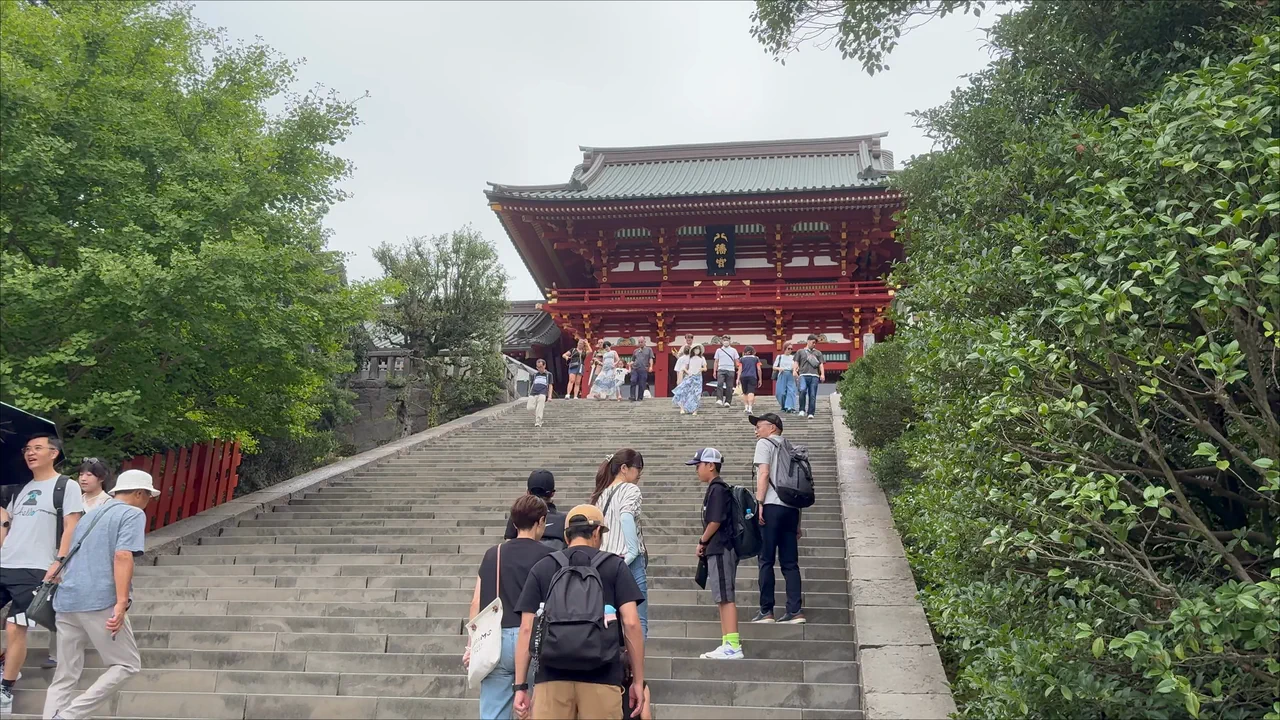
On this day, I walked from Kamakura Station along Dankazura to Tsurugaoka Hachimangu, then continued to Minamoto no Yoritomo’s Grave, Egara Tenjin Shrine, Hokokuji, and Jomyoji.
The video leaves out long historical explanations. This article adds the context behind the lotus ponds, shrine buildings, bamboo grove, and Zen garden shown on screen, together with observations from the walk itself.
In the late 12th century, Minamoto no Yoritomo established a warrior government with Kamakura as its base. Kyoto remained the home of the emperor and imperial court, while Kamakura became a new political center led by the warrior class. Many of the shrines, temples, and historic sites visited on this walk are closely connected to that change.
Kamakura walking route and map
I left the east exit of Kamakura Station, walked through Nino Torii and along Dankazura to Tsurugaoka Hachimangu, then continued east of the station area.
The order was Kamakura Station → Nino Torii and Dankazura → Tsurugaoka Hachimangu → Minamoto no Yoritomo’s Grave → Egara Tenjin Shrine → Hokokuji → Jomyoji. From Jomyoji, I walked back toward Tsurugaoka Hachimangu, passed through Komachi Street, and returned to Kamakura Station.
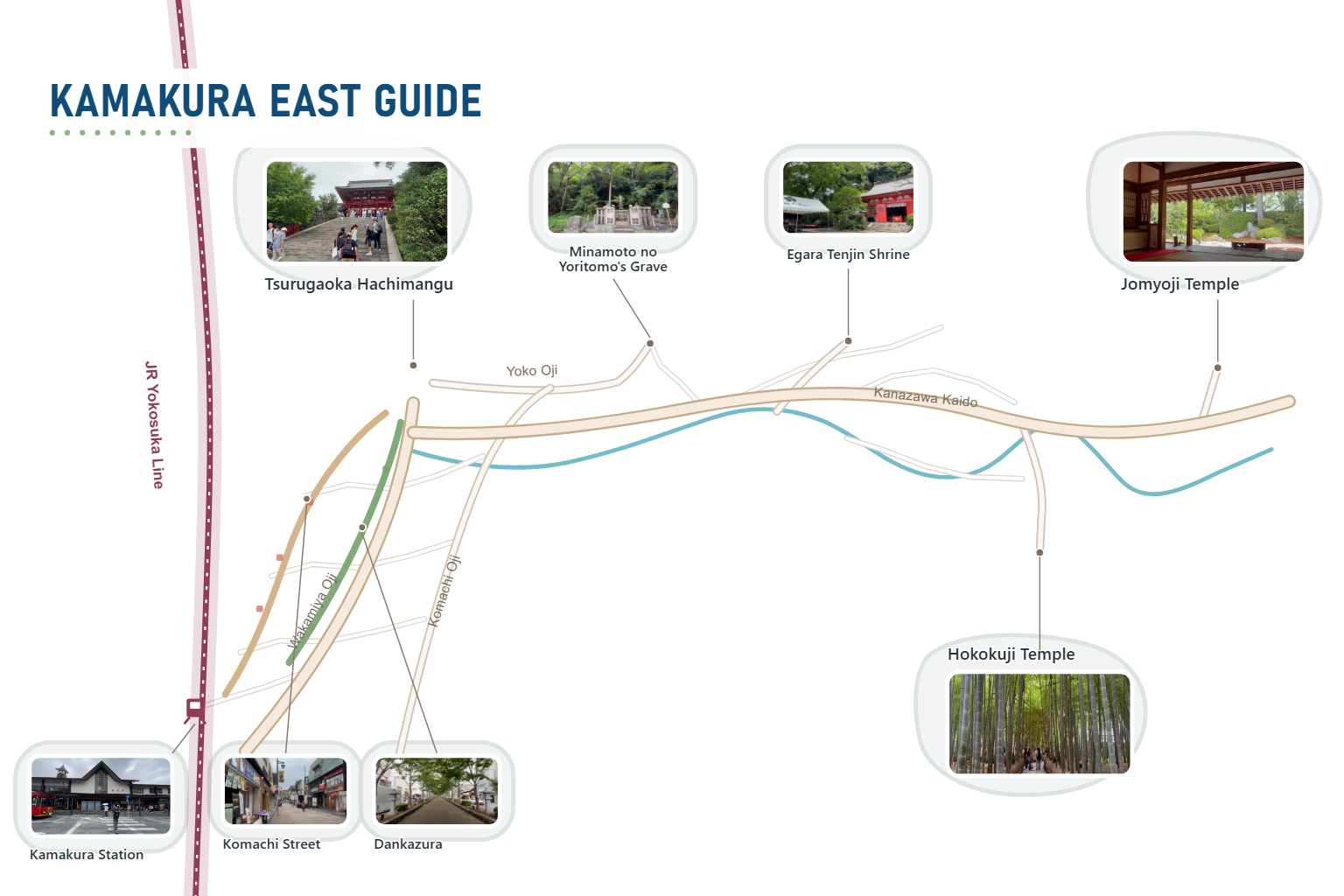
The main appeal of this course is that it continues beyond the station area and the great shrine. In one day, it connects the lotus-covered ponds of Tsurugaoka Hachimangu with sites related to the warrior government, Hokokuji’s bamboo grove, and the garden at Jomyoji. On the day I visited, foot traffic became lighter after I left Hachimangu and continued east. The route also gives a concise introduction to Kamakura’s warrior history through Yoritomo’s grave, Egara Tenjin Shrine, and two Zen temples.
This article stays with the places I actually visited. The Great Buddha, Hasedera, the Enoden railway, and the coast belong to different Kamakura routes and are not included here.
From Kamakura Station to Dankazura
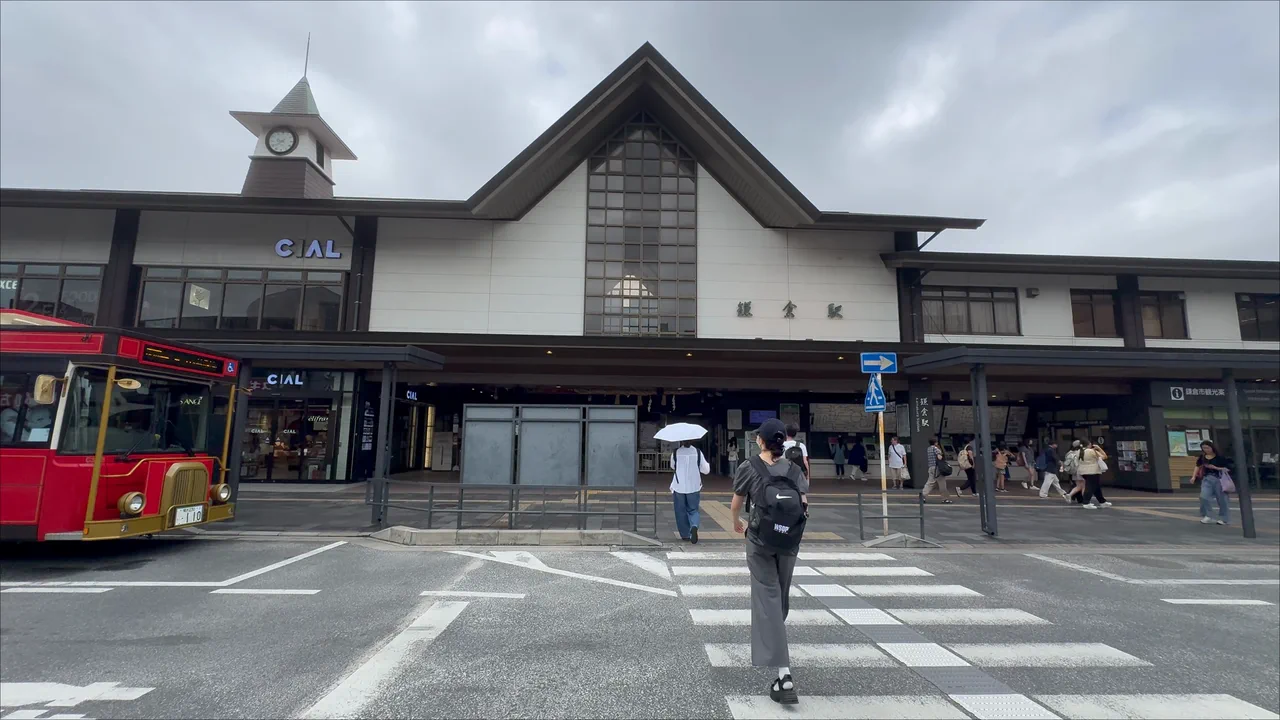
The opening scene is the east exit of JR Kamakura Station. People were moving through the station plaza while buses and taxis came and went. Instead of entering Komachi Street, I headed toward Nino Torii on Wakamiya Oji.
Dankazura begins at Nino Torii. It is a raised approach running along the center of Wakamiya Oji toward Tsurugaoka Hachimangu. Looking straight ahead between the trees, the route leads toward Sanno Torii and the shrine beyond it.
In the video, the movement of the station crowds gives way to a forward walk along Dankazura.
Tradition says that Minamoto no Yoritomo had Dankazura built in 1182 to pray for the safe delivery of his wife, Hojo Masako. The approach gradually becomes narrower as it gets closer to the shrine. This creates a perspective effect that makes the route appear longer and the shrine more distant, and is sometimes explained as a design intended to heighten the dignity of the approach.
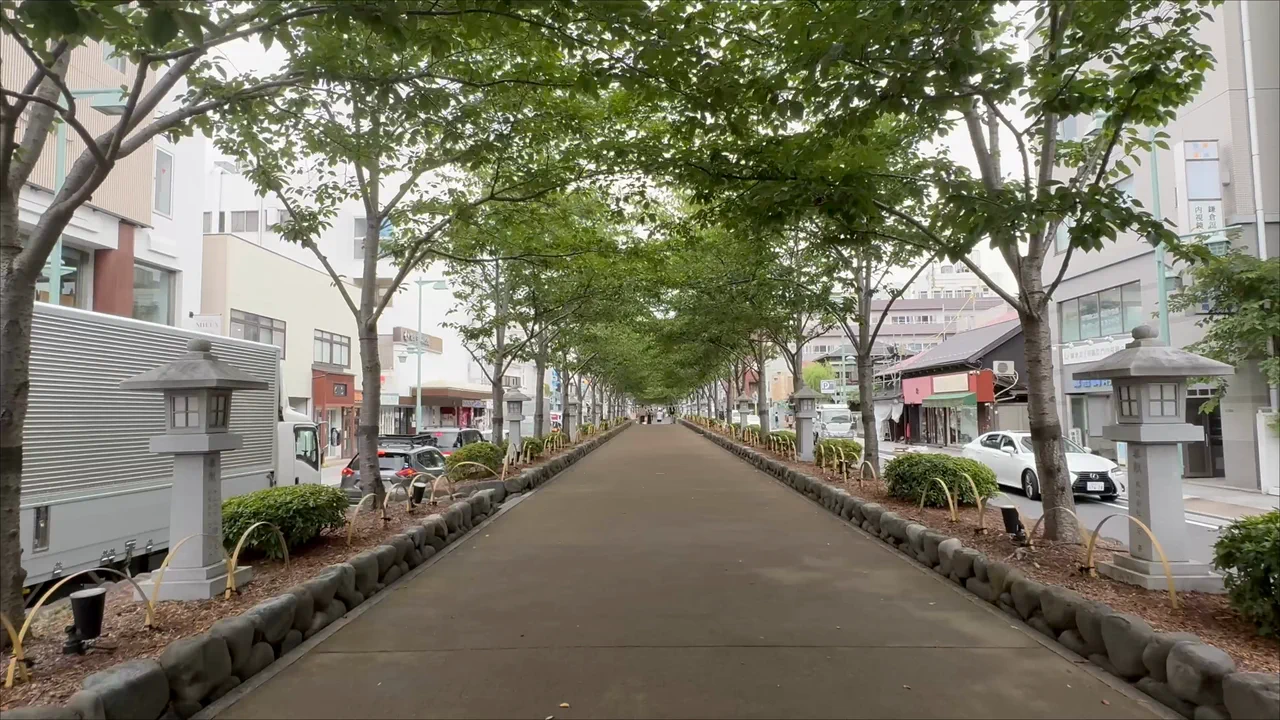
Wakamiya Oji and Tsurugaoka Hachimangu formed the central axis of Kamakura as the city developed around the warrior government. The present Dankazura is not preserved exactly as it was in medieval times; it has been repaired and reconstructed over the centuries.
Visitor information
- About a 10-minute walk from the east exit of JR Kamakura Station to Tsurugaoka Hachimangu
- No admission charge for Nino Torii or Dankazura
Tsurugaoka Hachimangu and the lotus-covered Genpei Ponds
The part of Tsurugaoka Hachimangu I filmed for the longest time was the pair of ponds near the entrance to the shrine grounds.
When I visited in late July, broad lotus leaves covered much of the water, with pale pink flowers appearing between them. I particularly liked this view, so the video lingers on wide views of the ponds, close views of the flowers and leaves, and the water’s edge.
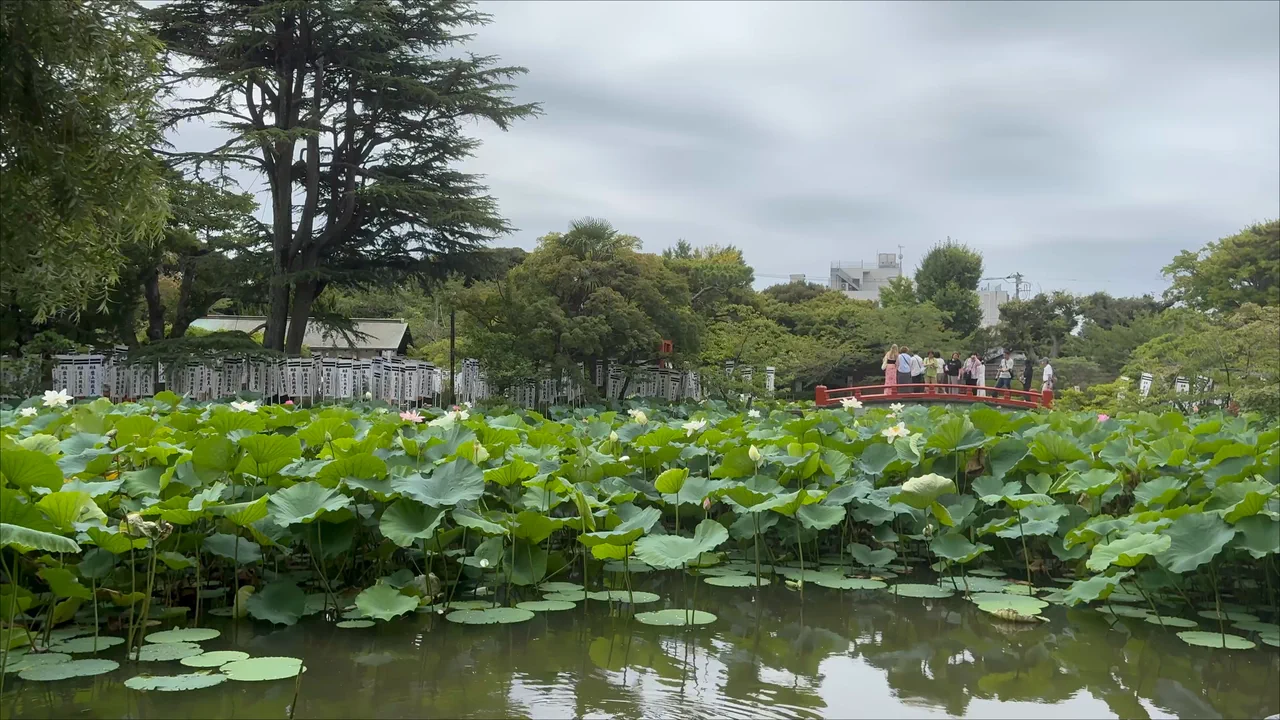
The torii and small shrine seen partway through this sequence belong to Hataage Benzaiten Shrine, which stands on an island in Genji Pond. According to tradition, Benzaiten’s divine favor aided Yoritomo when he raised an army. The present building was reconstructed in 1980 from an Edo-period drawing.
The Genpei Ponds are also traditionally attributed to Yoritomo. A well-known story associates the three islands in Genji Pond with the Japanese word for birth, while the four islands in Heike Pond are associated with death. The arrangement has therefore been interpreted as symbolizing the prosperity of the Minamoto clan and the fall of the Taira clan. This is a traditional explanation rather than a proven design record.
From the Maiden ceremonial stage to the main shrine
After the ponds, I passed the temizuya purification pavilion, rows of sake barrels offered to the shrine, ema prayer plaques, the Maiden ceremonial stage, the Great Stone Steps, and the main shrine.
The Maiden stands on the site of the former Wakamiya corridor, where Shizuka Gozen is said to have danced while thinking of Minamoto no Yoshitsune. The tradition refers to the earlier corridor, not to the present stage.
At the top of the Great Stone Steps, the straight approach can be seen extending back into the city. The present main shrine was rebuilt in 1828. Its main sanctuary, offering hall, worship hall, and related structures are designated Important Cultural Properties of Japan.
Hachiman was revered as a guardian deity by the Minamoto clan and many other warriors. Tsurugaoka Hachimangu traces its origins to 1063, and Yoritomo moved the shrine to its present location in 1180. He made it both a place of worship and a central symbol of the new warrior government and the city forming around it.
Visitor information
- Regular worship hours: 6:00–20:00
- No admission ticket is required for the grounds or main shrine
- Treasure Museum: 9:00–16:00; ¥200 for adults and ¥100 for elementary school students
Beyond Tsurugaoka Hachimangu: Yoritomo’s Grave and Egara Tenjin Shrine
After leaving Tsurugaoka Hachimangu and walking east, the scene changed to quiet residential streets. There were fewer visitors in this section on the day I walked it, although crowd levels vary by date and season.
Minamoto no Yoritomo’s Grave
A stone pagoda said to mark Yoritomo’s grave stands among trees at the top of a flight of stone steps. Few people were present when I visited, and the small terrace around the monument was quiet.
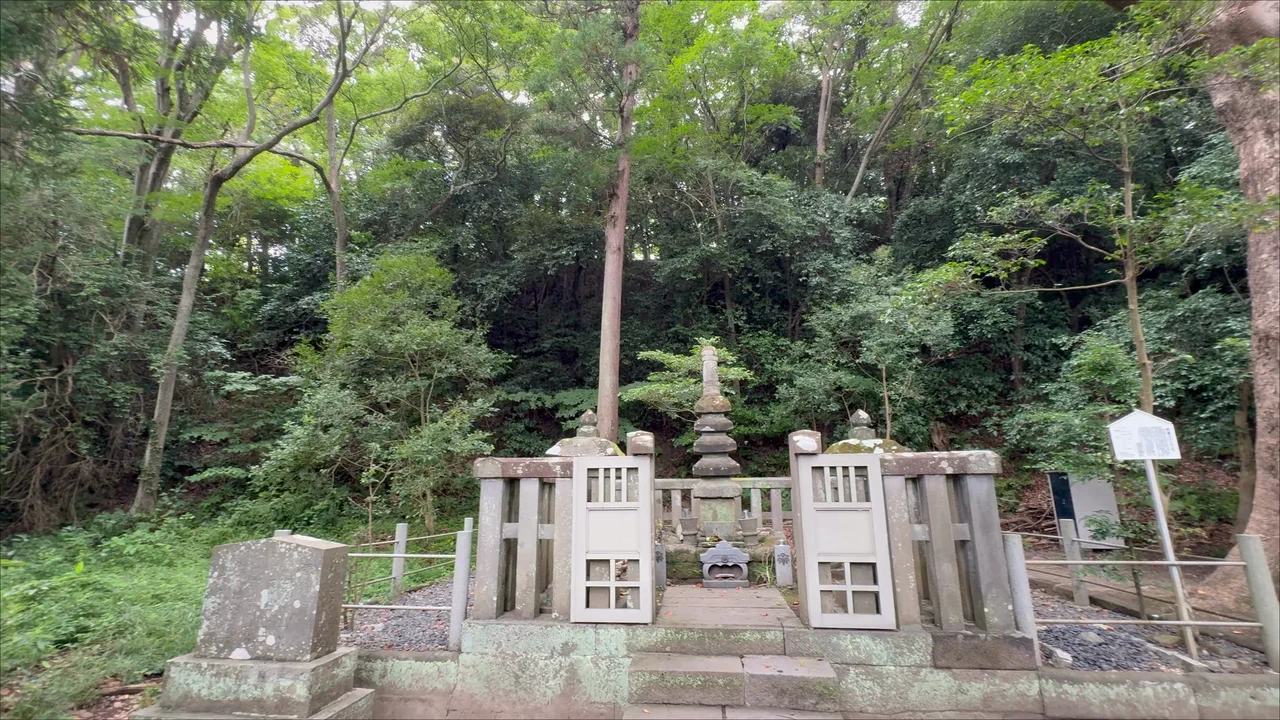
Minamoto no Yoritomo defeated the Taira, brought eastern warriors under his leadership, and established a government based in Kamakura. He became shogun in 1192 and laid the foundations of Japan’s first long-lasting warrior government. This government is known as the Kamakura shogunate.
Yoritomo’s mortuary hall, known as Hokkedo, is believed to have stood on this terrace. The present stone monument does not date from Yoritomo’s lifetime. The site was refurbished in 1779 under Shimazu Shigehide, lord of the Satsuma domain, and the stone pagoda is thought to date from that work.
Visitor information: Open access; no admission charge
Egara Tenjin Shrine
At Egara Tenjin Shrine, I saw the vermilion worship hall above the stone steps, ema prayer plaques, and the E-fude-zuka brush monument. Its surface is decorated with individual kappa reliefs based on drawings by 154 manga artists.
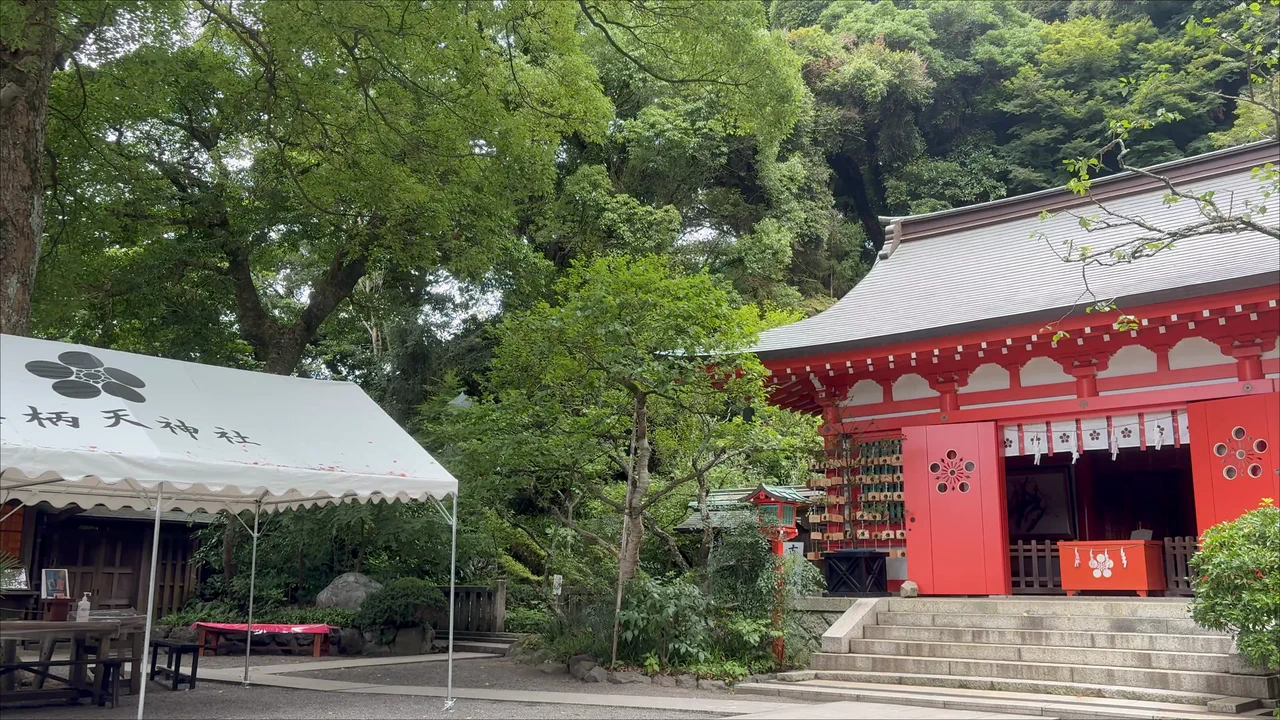
Egara Tenjin Shrine enshrines Sugawara no Michizane, a scholar and statesman of the Heian period who came to be worshipped as Tenjin, the deity of learning. Students still visit Tenjin shrines to pray for academic success and good examination results.
The shrine tradition dates its foundation to 1104. Yoritomo later revered it as a guardian shrine protecting the northeast of his government center in Kamakura. Behind the vermilion worship hall stands the main sanctuary, moved here in 1624 from the former Wakamiya sanctuary at Tsurugaoka Hachimangu. It is designated an Important Cultural Property of Japan.
The grounds were also quiet on the day I visited. This should not be treated as a permanent crowd forecast, especially during examination season or shrine events.
Visitor information: 8:30–16:30; no fixed admission fee, but offerings are welcome
Hokokuji: more than the bamboo grove
The Hokokuji sequence does not begin abruptly in the bamboo grove. After passing through the gate, the approach leads past moss, stepping stones, stone lanterns, and a small pond before reaching the main hall.
Beyond the main hall, a narrow path passes through tall bamboo. Moss-covered stone figures and lanterns stand near the path, while rock-cut tombs known as yagura can be seen in the cliff face. Because level land is limited in Kamakura, medieval residents developed a distinctive practice of cutting tombs and memorial spaces into the surrounding hillsides.
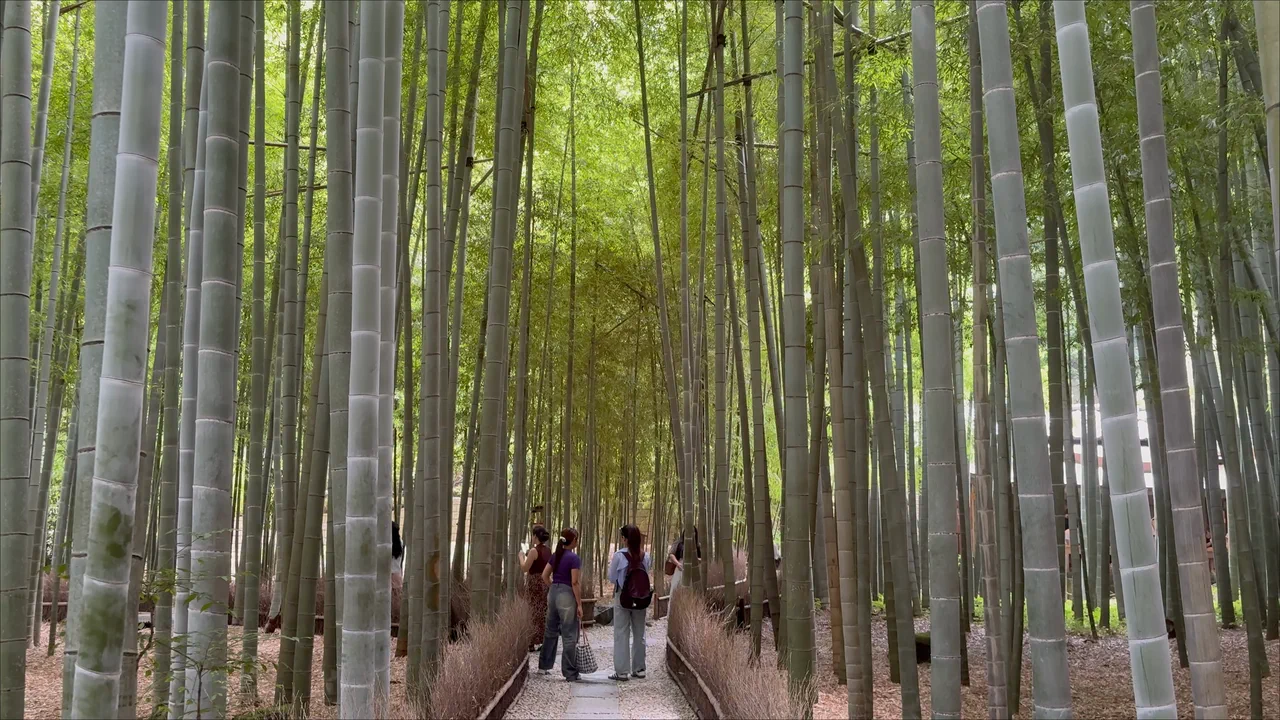
Hokokuji was founded in 1334 and belongs to the Kenchoji branch of the Rinzai school of Zen Buddhism. Zen emphasizes meditation and disciplined practice, and it developed close ties with the warrior class during the medieval period. Roughly 2,000 bamboo stalks now grow in the garden behind the main hall.
Matcha is also available at Hokokuji
Kyukouan, inside the Bamboo Garden, serves matcha with a small dry sweet while visitors look out at the bamboo. The tea ticket is purchased at the garden reception, and sales may be paused when it is crowded.
I did not visit Kyukouan on this trip. The matcha shown in the video was served at Jomyoji, the next stop.
Visitor information
- Visiting hours: 9:00–16:00
- Admission: ¥400 for high school students and adults; ¥200 for elementary and junior high school students
- Kyukouan: 9:00–15:30; matcha with a dry sweet ¥600
- Closed to visitors from December 29 to January 3; access may also be suspended because of weather
Jomyoji: the quietest stop of this visit
At Jomyoji, I first saw the main hall and carefully maintained grounds, then entered Kisen-an. From the tatami room, the view opens onto a dry landscape garden composed of white gravel, garden stones, and clipped shrubs.
I had matcha and a sweet here. The same garden feels different when viewed from inside the room, from the veranda, and from directly in front. On this visit, few people were present, and I could sit with the sound of leaves while looking across the garden.
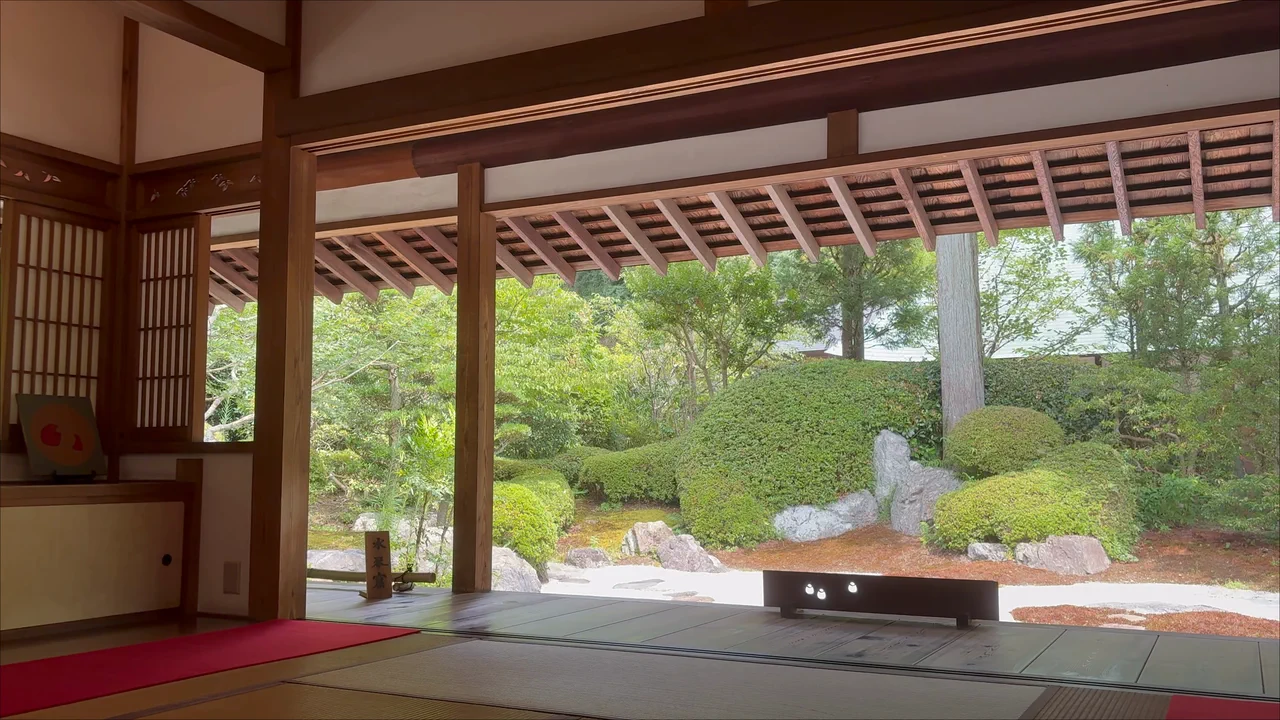
Hokokuji’s Kyukouan also offers matcha with a view of bamboo. On the day I visited, however, Kisen-an at Jomyoji was the quieter place to sit. Conditions will vary by day and time.
Jomyoji is traditionally said to have been founded in 1188 by the warrior Ashikaga Yoshikane. It began as a temple of esoteric Buddhism called Gokurakuji and was later converted into a Rinzai Zen temple.
Jomyoji ranks fifth among the Kamakura Gozan. The Gozan system ranked five leading Zen temples protected by the shogunate. These temples were important not only as religious institutions but also as centers of scholarship and culture.
Visitor information
- Visiting hours: 9:00–16:30
- Admission: ¥200 for adults and ¥100 for elementary school students
- Kisen-an: 10:00–16:30; last order at 16:15
- Matcha: ¥660 with a dry sweet or ¥1,100 with a seasonal fresh sweet
Practical information before walking this course
Food and rest stops
There are restaurants and cafes around Hokokuji and Jomyoji, but they are not concentrated along the street in the same way as around Kamakura Station and Komachi Street. If you have a particular place in mind, check its opening days and hours before setting out.
For a rest inside a temple, Kyukouan at Hokokuji offers matcha with a view of the bamboo, while Kisen-an at Jomyoji offers matcha beside the dry landscape garden.
Returning to Kamakura Station by bus
You can walk back from Jomyoji toward Kamakura Station, or take a Kamakura-bound bus on route Kama 23 or Kama 24 from the Jomyoji bus stop. The regular fare is ¥240.
The Kamakura Free Environment Pass costs ¥900 for an adult. If you walk this course and use the bus only once on the way back, paying the regular fare is cheaper. Consider the pass only on a day when you will use several covered bus sections or the specified section of the Enoden railway.